Buy Now, Pay Later (BNPL): Complete Guide
Financial Guidance Disclaimer
This article provides educational information only and does not constitute financial advice. Financial decisions should be based on your personal circumstances.
Buy Now, Pay Later (BNPL): Complete Guide
Buy Now, Pay Later (BNPL) is a form of short-term financing that allows consumers to purchase goods or services and repay the amount over multiple installments. Some BNPL products may offer no interest when payments are made on time, while others may involve interest, fees, or other costs depending on the provider and agreement. BNPL has rapidly become a familiar option at online checkouts and in physical stores. It promises convenience and flexibility, but understanding exactly what you are agreeing to—beyond the first installment—is essential. This guide explains how BNPL works, what it costs, how it compares with other forms of payment, and what to consider before choosing it for your next purchase.
What Is Buy Now, Pay Later?
Buy Now, Pay Later refers to point‑of‑sale installment loans that allow you to split a purchase into a series of smaller payments over time. Typically, the first payment—sometimes called a down payment—is due at checkout, with the remaining balance divided into equal installments billed every two weeks or monthly. The number of payments, total cost, and terms vary by provider and product.
BNPL sits at the intersection of retail and short‑term credit. It is not a single standardized product. Some plans charge no interest if you pay on time. Others carry an annual percentage rate (APR) comparable to a credit card. Some are offered directly by merchants, while most are administered by third‑party fintech companies that partner with retailers.
It is important to understand that BNPL is not "free money." Even a 0% APR plan can have late fees, and a purchase financed through BNPL is still a debt that must be repaid. The term "pay later" describes the timing of the payments, not a reduction in the total amount owed.
How BNPL Works
While specific processes differ, most BNPL transactions follow a similar path.
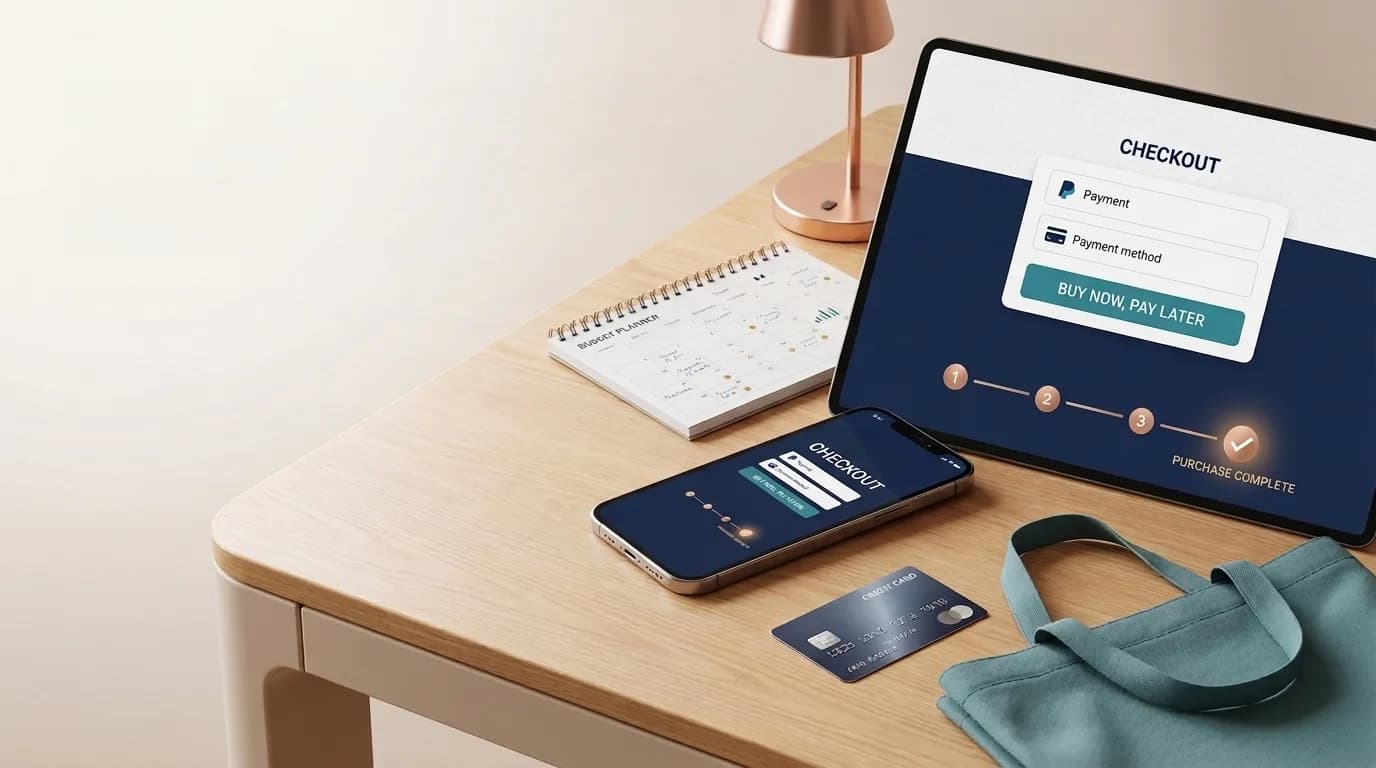
Step 1: Select BNPL at checkout. You may see the option when shopping online, in a retailer’s app, or at a physical register. Some providers also offer virtual cards that let you use BNPL anywhere the card network is accepted.
Step 2: Review the terms. Before accepting, the provider should disclose the purchase price, down payment (if any), number of installments, payment amounts, payment dates, APR (if applicable), late fees, and any other charges. Read these carefully. Do not rely on marketing language alone. Understand the total amount you will pay and when each payment is due.
Step 3: The provider evaluates the transaction. Approval may be instant. The information reviewed can include your identity, the purchase amount, your history with that provider, and, in some cases, a credit check. Soft inquiries may not affect your credit score; hard inquiries can, though not all providers use them. Policies vary, so review the provider’s current disclosures.
Step 4: Complete the purchase. The merchant is paid (minus a fee) by the BNPL provider. You now owe the provider—or a partner lender—the agreed installment payments. The item you purchased is yours, but the debt remains until it is fully repaid.
Step 5: Make payments. Payments are usually automatic, withdrawn from your debit card, bank account, or credit card on set dates. You may receive reminders. Some providers allow early repayment without penalty. If a payment fails, you could face a late fee and, potentially, other consequences.
Step 6: The obligation ends. Once all payments are made, the contract is complete. If you paid on time and the plan was interest‑free, the total you paid equals the purchase price.
Hypothetical BNPL Example
This is a simplified hypothetical example. Actual terms and results vary by provider, product, and borrower behavior.
A consumer buys a $400 item using a BNPL plan that requires four equal installments over six weeks, with no interest if paid on time. The payment schedule is:
Down payment: $100 at checkout
Installment 2: $100 two weeks later
Installment 3: $100 four weeks later
Installment 4: $100 six weeks later
Total paid: $400.
Now suppose the same plan charges a $7 late fee for any missed payment, and the consumer misses the second installment, paying it five days late. That adds $7 to the total cost, making the total $407. If the plan instead carried an APR of 20% on the declining balance and the consumer made all payments on time, the interest would be calculated based on the daily outstanding principal. Under a simple interest calculation with the same four‑payment schedule, the total interest would be approximately $7–$8, not $15 as previously illustrated. The total cost would then be roughly $408.
The example illustrates that the final cost depends on the specific terms, interest rate, fees, and your payment behavior. Never assume that a "0% interest" offer is automatically cheaper than alternatives; late fees and other charges can quickly erode any advantage.
How BNPL Providers Make Money
BNPL providers generate revenue through several channels:
Merchant fees: Retailers pay a percentage of each transaction to the BNPL provider, similar to the fees paid for credit card processing, though the structures differ.
Late fees: Some providers charge late fees, while others have eliminated them on certain products. Where charged, they can contribute to revenue.
Interest: For interest‑bearing products, the provider earns interest on the outstanding balance.
Consumer fees: Some plans may charge account maintenance fees, payment rescheduling fees, or other service charges.
Other financial services: Some providers offer additional products, such as longer‑term loans, virtual cards, or banking services, which generate their own revenue.
A plan marketed as "0% interest" can still be profitable for the provider because of the merchant fees it collects and, if you pay late, any late fees it charges. The cost of the financing is built into the merchant’s pricing or the provider’s fee structure, not necessarily eliminated.
Is BNPL Really Interest‑Free?
Not always. Many BNPL products are structured as short‑term, interest‑free installment plans—often called "pay in four" plans—but others carry an APR comparable to a credit card. The existence of a 0% APR offer depends on the provider, the specific product, your creditworthiness, and the purchase amount.
A zero‑interest offer is not automatically cost‑free. Late payment fees, missed payment consequences, and the risk of overdraft can all impose costs that are not reflected in the APR. Moreover, the convenience of installment payments can encourage spending that wouldn't occur if you had to pay the full price upfront.
Always review the specific terms of the plan you are offered. Look for the APR, late fee structure, and any other charges. If the information isn't clear, ask before you accept.
BNPL Fees and Costs
BNPL costs can be grouped into direct and indirect categories.
Direct BNPL fees may include:
Interest charges on interest‑bearing plans.
Late payment fees.
Payment rescheduling fees.
Account maintenance fees.
Fees for using certain payment methods.
Indirect costs may include:
Overdraft or insufficient‑funds fees charged by your bank if a BNPL payment is attempted against a low balance.
Credit score consequences if a missed payment is reported or an account goes to collections.
Reduced cash flow flexibility because money is already committed to installments.
Not every provider charges every type of fee. For example, some major U.S. BNPL providers do not charge late fees on their standard pay‑in‑four products, while others do. The only way to know is to review the terms for the specific transaction.
BNPL vs. Credit Cards
Feature | BNPL | Credit Card |
|---|---|---|
Repayment structure | Usually fixed installments | Revolving credit; minimum payment plus optional additional payments |
Interest | Product‑dependent; may be 0% or carry an APR | Usually applied when a balance is carried beyond the grace period |
Payment schedule | Predetermined dates | Flexible within the billing cycle |
Credit limit | Transaction‑based; provider‑dependent | Revolving credit limit |
Late‑payment consequences | Vary by provider; may include fees, restricted access, and credit reporting | Late fees, penalty APR, possible credit‑score impact |
Credit reporting | Varies; some providers report, some do not | Routinely reported to major credit bureaus |
Rewards | Usually none, though some providers offer perks | Often available (cash back, points, miles) |
Consumer protections | Depend on product structure and applicable law | Established statutory protections (e.g., Reg Z dispute rights) |
Repeated borrowing risk | Possible; easy to stack multiple plans | Possible; high utilization can affect credit |
Neither product is universally better. A credit card with a grace period paid in full offers similar float without installments, and may provide stronger dispute rights. A 0% APR BNPL plan can be useful if you are certain you can pay on time and have accounted for the total cost. The right choice depends on the specific terms and your financial habits.
BNPL vs. Personal Loans
Personal loans typically involve larger amounts, longer repayment periods, and a formal application process with a credit check. Interest rates on personal loans are often lower than credit card APRs for borrowers with good credit, but they may be higher than the 0% offers on some BNPL plans.
BNPL is generally faster and requires less information, but the loan amounts are smaller and the repayment periods shorter. Personal loans are amortizing installment debt; BNPL can be either installment debt or, in some cases, a series of deferred payments. For a larger, planned expense, a personal loan may offer a structured, predictable repayment schedule. For a one‑time retail purchase, BNPL may be more convenient if the terms are favorable and you can repay on time.
BNPL vs. Debit Cards and Cash
Paying with existing funds—cash or a debit card—avoids creating a new debt obligation. You know the exact cost and face no ongoing payment obligations, late fees, or credit‑reporting implications.
Paying over time with BNPL preserves cash in the short term but commits future income. If your budget is tight, that future commitment can create stress. If you already have the money to pay in full and can do so comfortably, using BNPL adds complexity without financial benefit. When you don't have the full amount, BNPL can be a financing tool, but the underlying question remains: can you afford the purchase itself, not just the installment?
Does BNPL Affect Your Credit Score?
BNPL’s impact on your credit score depends on whether information is reported, to which bureau, and how it appears. The process involves three distinct stages:
Credit inquiry: Applying for BNPL may trigger a soft or hard inquiry. Soft inquiries do not affect scores. Hard inquiries can cause a small, temporary dip. Some providers perform hard pulls, particularly for larger or interest‑bearing plans.
Account reporting: Some BNPL providers report the account opening to one or more credit bureaus. Others do not. If the account appears, it may affect the average age of accounts and total debt shown on your report.
Payment reporting: On‑time payments may be reported to help build credit, but this is uncommon for pay‑in‑four plans. Missed payments or accounts sent to collections can be reported and hurt your score.
As of early 2025, Experian includes BNPL data when furnished by participating providers. TransUnion also accepts BNPL information. Equifax has similar capabilities. However, furnishing is voluntary; many short‑term BNPL plans are never reported. Because practices vary, review each provider’s current policy. Do not assume BNPL will either help or hurt your credit—it depends entirely on what is reported and how.
Can BNPL Build Credit?
BNPL can potentially help build credit if (1) the provider reports your payment history, (2) you pay on time, and (3) the scoring model uses that information. Most traditional pay‑in‑four plans do not report positive payment data. Relying on BNPL as a primary credit‑building tool is generally not advisable; products like secured credit cards or credit‑builder loans are designed for that purpose and are more consistently reported.
What Happens If You Miss a BNPL Payment?
Consequences vary by provider and product. Potential outcomes include:
A late fee, which may be a flat dollar amount or a percentage of the missed installment.
Suspension of your ability to make new purchases with that provider.
Reporting of the missed payment to one or more credit bureaus, which could lower your credit score.
The account may eventually be sent to collections if it remains unpaid.
If automatic payments are set up and your bank account lacks sufficient funds, you may also incur an overdraft or insufficient‑funds fee from your bank.
If you anticipate missing a payment, contact the provider promptly. Some offer hardship options or payment rescheduling. Communication can sometimes prevent the most severe consequences.
BNPL and Overdraft Risk
Because BNPL payments are frequently automatic, they can be attempted even when your bank account balance is low. A single failed payment could trigger both a late fee from the BNPL provider and an overdraft fee from your bank. If multiple BNPL payments hit on the same day, the impact can be compounded.
To reduce this risk, maintain a buffer in your checking account, track all scheduled BNPL payments on a calendar, and consider linking your BNPL account to a dedicated account that always carries sufficient funds. Reviewing your upcoming payments weekly can help you avoid surprises.
BNPL and Budgeting
A $50 installment every two weeks may feel inconsequential, but four active BNPL plans each with a $50 biweekly payment create a recurring obligation. Biweekly payments total 26 per year, so four plans would mean $200 every two weeks, or about $433 per month on average ($50 × 26 = $1,300 annually per plan, divided by 12). Because BNPL payments are spread out, they can fragment your sense of total spending. This is known as mental accounting—treating each small installment as separate from your overall budget, rather than as part of a larger liability.
To use BNPL safely within a budget:
Track all active plans in one place, with total remaining balances and payment dates.
Before accepting a new BNPL offer, add the installments to your existing monthly obligations and check whether the total still fits your spending plan.
Remind yourself that the purchase price is the real cost—the installment is just how it's sliced.
Behavioral Finance and BNPL
Research in behavioral economics helps explain why BNPL is both appealing and potentially risky. Key concepts include:
Present bias: People tend to favor immediate gratification over future costs. A small upfront payment makes the purchase feel cheaper, even if the total price hasn't changed.
Mental accounting: Consumers often treat each BNPL plan as a separate, small commitment rather than as part of their overall debt load.
Payment salience: Frequent small payments can feel less painful than one large payment, reducing the psychological brake that might otherwise curb spending.
Impulse purchasing: When BNPL is seamlessly integrated at checkout, it can reduce the time between desire and purchase, making it easier to buy on impulse.
A 2023 report by the Consumer Financial Protection Bureau (CFPB) found that BNPL users tend to be younger, have lower incomes, and are more likely to show signs of financial distress compared to non‑users. Repeat BNPL users often carry multiple plans and experience higher rates of late fees and overdrafts. The report does not establish that BNPL causes these outcomes; other factors may be at play. However, it highlights that the convenience of installment payments can mask the true cost of borrowing and encourage spending that might not occur if the full price were paid upfront.
Potential Benefits of BNPL
Predictable installments: Fixed payment schedules can help some consumers plan cash flow around paydays.
Potentially low or no interest: Some products offer 0% APR when paid on time, which can be less expensive than carrying a credit card balance.
Defined repayment period: Unlike revolving credit, installment plans have a clear end date, which may help with budgeting.
Convenience: BNPL is often integrated directly into the checkout flow, reducing friction.
Access: Some consumers who have limited credit history or prefer not to use credit cards may find BNPL more accessible.
These benefits are conditional: they depend on choosing the right product, reading the terms, and making every payment on time.
Risks and Disadvantages
Overspending: The low upfront cost can make purchases feel more affordable than they are.
Payment stacking: Multiple concurrent BNPL plans can create a large aggregate monthly obligation.
Missed payment consequences: Late fees, credit score damage, and collections are possible.
Overdraft risk: Automatic payments can trigger bank fees if funds are insufficient.
Refund complexity: Returning an item doesn't automatically cancel the loan; payments may still be due while the refund is processed.
Limited consumer protections: Depending on the product structure, some BNPL plans may not carry the same dispute rights as credit cards.
Variable terms: Policies on fees, interest, and credit reporting differ by provider and can change over time.
The biggest risk for many consumers is not a single plan, but the accumulation of multiple small obligations that together strain their monthly cash flow.
Multiple BNPL Plans
Hypothetical example: A consumer has four active BNPL plans, each requiring $50 biweekly.
Plan A: $50 every two weeks
Plan B: $50 every two weeks
Plan C: $50 every two weeks
Plan D: $50 every two weeks
Combined biweekly total: $200. Over the course of a year, total BNPL payments would be $200 × 26 = $5,200, or an average of about $433 per month. This is in addition to rent, groceries, and other bills.
To manage multiple plans:
Keep a running list of all active BNPL obligations.
Check the list before making a new purchase.
Consider pausing new BNPL use until existing plans are paid off.
Set calendar reminders for each payment date.
Essential vs. Discretionary Purchases
There is no universal rule that BNPL should only be used for essentials. However, financing a necessary expense—such as a car repair or medical bill—can be particularly risky if your budget is already stretched. If you must finance a necessity, compare the total cost of all available options. For discretionary purchases like clothing or entertainment, the question is simpler: if you cannot afford the purchase without BNPL, it may be worth waiting until you can.
When BNPL May Be Reasonable
BNPL may be a manageable choice when:
The purchase is already budgeted and fits comfortably within your cash flow.
The payment schedule aligns with your income.
You have read the terms and understand the total cost, fees, and consequences.
You are not carrying multiple other BNPL plans or high‑interest debt.
You are using BNPL for a specific, planned reason, not as a routine method of stretching your paycheck.
Warning Signs
Circumstances that warrant extra caution include:
You cannot afford the purchase without BNPL and do not have a clear plan to cover the installments.
You already have several active BNPL plans.
You frequently carry a balance on credit cards.
Your income is unpredictable.
You have overdrafted your bank account in the past few months.
You do not know the total amount you owe across all BNPL accounts.
You are using BNPL to pay for everyday living expenses.
None of these mean you shouldn't use BNPL, but they suggest a need to pause and carefully evaluate the impact on your finances.
BNPL and Emergency Expenses
Emergencies by definition are unpredictable, and short‑term BNPL plans are not designed for them. The short repayment window and automatic payment features can create additional stress if your income has been disrupted. If you face a true emergency expense, consider alternatives first: community assistance programs, payment plans directly through the provider (such as a hospital), or drawing from emergency savings. Using BNPL to cover an emergency may solve one problem while creating another.
Returns and Refunds
If you return an item purchased with BNPL, the refund process depends on the merchant and the BNPL provider. Typically, the merchant processes the refund, and the BNPL provider adjusts your payment schedule or issues a refund to your original payment method. However, this can take days or weeks.
It is generally wise to continue making scheduled payments until you receive confirmation that the refund has been applied and the remaining balance canceled. Stopping payments on your own could result in late fees or other consequences if the provider has not yet processed the return. Retain all documentation and monitor your BNPL account until the matter is fully resolved.
BNPL Disputes and Consumer Protection
If merchandise is defective, does not arrive, or a charge is incorrect, you should:
Contact the merchant first to attempt resolution.
Notify the BNPL provider of the dispute and follow their procedures.
Document all communications, save screenshots, and keep receipts.
If the issue remains unresolved, you may escalate to relevant consumer protection agencies, such as the CFPB or your state attorney general.
Your rights depend on the product structure, the provider, and applicable laws. In 2024, the CFPB issued an interpretive rule stating that BNPL providers that extend credit for purchases and meet certain criteria are considered "card issuers" under Regulation Z, which implements the Truth in Lending Act. This interpretation means those providers must generally investigate disputes, pause payment requirements during the investigation, and credit refunds when appropriate. The rule does not apply to every BNPL product, and its legal status may be subject to change. Consumers should check the provider's current policies and applicable law.
Fraud and Security
Protect your BNPL accounts the same way you protect any financial account. Use strong, unique passwords and enable multi‑factor authentication when available. Monitor your account and linked payment methods for unauthorized transactions. Beware of phishing attempts that mimic BNPL providers or merchants. If you suspect fraud, report it to the provider immediately and follow their instructions for securing your account.
BNPL Regulation
As of early 2025, BNPL regulation in the United States continues to evolve. The CFPB has taken an active role, issuing an interpretive rule in May 2024 that brings certain BNPL products within the scope of Regulation Z. This interpretation requires covered providers to offer dispute and refund protections similar to those for credit cards. Not all BNPL products are automatically subject to the rule; applicability depends on the product's specific structure and terms.
Separately, the CFPB has examined BNPL practices in reports on consumer debt and credit reporting. State regulators have also introduced or enacted BNPL‑specific laws, adding to a fragmented regulatory landscape. Because rules can change, consumers should consult the CFPB and applicable state agencies for the most current information. This article does not provide legal advice.
BNPL and Consumer Rights
Depending on the product and applicable law, consumers may have rights related to clear disclosures, billing disputes, unauthorized transactions, and refunds. However, the scope of these rights is not uniform. Review the provider's terms and any applicable regulatory guidance. If you believe your rights have been violated, you can file a complaint with the CFPB or your state's consumer protection office.
BNPL Privacy and Data
Depending on the provider, BNPL services may collect transaction data, payment history, and, in some cases, device or browsing information. Such data might be shared with third parties for marketing, analytics, or other purposes. Before signing up, review the provider's privacy policy to understand what information is collected and how it is used.
BNPL and Overall Financial Health
BNPL is a financial tool, not a substitute for a sustainable budget. If you find yourself regularly relying on BNPL to cover everyday expenses or to bridge gaps between paychecks, that may signal a deeper cash‑flow issue. Building an emergency fund, reducing high‑interest debt, and creating a realistic spending plan can strengthen your overall financial position and reduce the need for short‑term financing.
Common BNPL Mistakes
Focusing only on the installment amount.
Ignoring the total purchase price.
Assuming 0% interest means zero cost.
Missing payment dates.
Stacking multiple BNPL plans without tracking the total.
Forgetting automatic payments are scheduled.
Assuming BNPL never affects credit.
Assuming BNPL always builds credit.
Misunderstanding refund procedures.
Financing impulse purchases.
Using BNPL to cover recurring budget deficits.
Ignoring overdraft risk.
Not reading the agreement.
Assuming all BNPL providers have identical terms.
Practical BNPL Checklist
Before accepting a BNPL plan, ask:
What is the total purchase price?
How many payments will I make?
How much is each payment?
When is each payment due?
Is there interest?
Are there late fees or other charges?
Will payments or missed payments be reported to credit bureaus?
What happens if I miss a payment?
What happens if I return the item?
Can I comfortably afford the full purchase price?
Do I already have other BNPL obligations?
Would I still make this purchase without BNPL?
BNPL Decision Framework
Green Light: The purchase fits your budget and cash flow. Terms are clear and acceptable. You have no other BNPL obligations that would make this payment difficult. You understand the refund process and your rights.
Yellow Light: You have several existing BNPL plans. Your income is irregular. You have not fully read the terms. The purchase is discretionary and you would not pay cash for it. You are uncertain about the total cost.
Red Light: You are using BNPL to pay for necessities because your income is insufficient. You already carry high‑interest debt. You have overdrafted recently. You do not know how many BNPL plans you have or their total cost. The purchase is clearly unaffordable without financing.
Hypothetical Scenarios
These are simplified examples for illustration. Actual outcomes depend on specific terms and individual circumstances.
Example 1 — Planned Purchase: Jordan has $600 saved for a laptop. The retailer offers a 0% BNPL plan over six weeks. Jordan chooses BNPL, keeps the $600 in a savings account, and pays each installment on time. Total cost: $600.
Example 2 — Impulse Purchase: Taylor sees a $300 jacket and uses BNPL with four installments of $75. Taylor didn't plan for the expense and later struggles to cover a utility bill. The low installment made the jacket feel affordable, but the total cost still reduced Taylor's available cash.
Example 3 — Multiple Plans: Casey has five active BNPL plans. Individual biweekly payments range from $20 to $60. Combined, they total $180 every two weeks. Casey's part‑time income barely covers the payments, leaving little for other expenses.
Example 4 — Missed Payment: Alex misses a $40 BNPL payment by three days. The provider charges a $7 late fee. The provider does not report the late payment, but Alex is now restricted from making new purchases with that provider until the plan is paid. (This example assumes a hypothetical late‑fee structure for illustration only.)
Example 5 — Refund: Sam returns a $120 item after making one $30 payment. The merchant processes the refund, and a week later the BNPL provider cancels the remaining payments and refunds the $30. Sam continued making scheduled payments until the refund was confirmed, avoiding a potential late fee.
Comparison Tables
BNPL vs. Credit Cards
Feature | BNPL | Credit Card |
|---|---|---|
Repayment | Usually fixed installments | Revolving credit; minimum payment plus optional additional payments |
Interest | Product‑dependent; may be 0% or carry an APR | Usually applied when a balance is carried beyond the grace period |
Payment schedule | Predetermined dates | Flexible within the billing cycle |
Credit limit | Transaction‑based; provider‑dependent | Revolving credit limit |
Late‑payment consequences | Vary; may include fees, restricted access, and credit reporting | Late fees, penalty APR, possible credit‑score impact |
Credit reporting | Varies; some report, some do not | Routinely reported to major bureaus |
Consumer protections | Depend on product structure and law | Established statutory protections (e.g., Reg Z) |
BNPL vs. Personal Loans
Feature | BNPL | Personal Loan |
|---|---|---|
Typical amount | Small to moderate | Moderate to large |
Repayment term | Weeks to months | Months to years |
Interest | Product‑dependent | Usually fixed APR |
Application | Quick, often at checkout | Formal application, credit check |
Usage | Retail purchases | Broad purposes |
BNPL vs. Debit/Cash
Feature | BNPL | Debit/Cash |
|---|---|---|
Debt created | Yes | No |
Interest | Possible | None |
Fees | Possible | Account fees possible (debit) |
Immediate cash outlay | Partial | Full |
Missed‑payment risk | Yes | None |
Alternatives to BNPL
When deciding how to pay, compare the total cost, APR, fees, repayment period, payment flexibility, missed‑payment consequences, dispute protections, and credit‑reporting treatment. Alternatives include:
Paying with cash or a debit card: no financing debt, no late fees.
Using a credit card and paying the balance in full: similar float, plus rewards and stronger dispute rights.
Saving ahead of time and delaying the purchase until you have the full amount.
A personal loan for larger, planned expenses.
Layaway plans, where the item is held until fully paid.
The appropriate option depends on your financial situation and the specific terms you're offered.
Responsible BNPL Use
If you decide to use BNPL, consider these practices to reduce risk:
Track all plans in a single spreadsheet or app.
Set calendar reminders for each payment date.
Keep a sufficient balance in the account used for payments.
Decide on a personal limit for the number or total amount of active BNPL obligations that fits your budget.
Review each new plan's terms before accepting.
Monitor your credit reports periodically.
Save documentation until the plan is fully paid and any refunds are finalized.
Frequently Asked Questions
What is Buy Now, Pay Later?
Buy Now, Pay Later is a form of short‑term financing that lets you split a purchase into installments, often with the first payment due at checkout. Some plans charge no interest if paid on time; others may carry an APR. Terms, fees, and credit‑reporting practices vary by provider.
How does BNPL work?
You select BNPL at checkout, review the payment schedule and terms, and, if approved, pay a down payment. The remaining balance is divided into equal installments, typically paid automatically every two weeks or monthly. The provider pays the merchant; you repay the provider.
Is BNPL a loan?
BNPL is generally a form of consumer credit or installment financing. The legal classification can differ by product structure and jurisdiction. Most BNPL plans create a debt obligation that must be repaid according to the agreed schedule.
Does BNPL charge interest?
Some BNPL products charge 0% APR; others carry an interest rate. Whether interest applies depends on the provider, the specific plan, and sometimes your credit profile. Always check the terms for the APR before accepting.
Does BNPL affect your credit score?
It can, depending on whether information is reported. Some providers perform hard or soft credit inquiries. Some report payment history; others do not. Missed payments or collections can damage your score if reported. Review the provider's current policy.
Does BNPL help build credit?
Only if the provider reports on‑time payments to a credit bureau and the scoring model uses that data. Most pay‑in‑four plans do not report positive history. BNPL is not a reliable credit‑building tool compared to products designed for that purpose.
What happens if you miss a BNPL payment?
Consequences vary. You may be charged a late fee, lose the ability to make new purchases with that provider, or have the missed payment reported to credit bureaus. If automatic payments fail, your bank may also charge overdraft fees.
Are BNPL services safe?
Reputable BNPL providers use encryption and security measures similar to other financial platforms. However, no system is immune to fraud. Protect your account with a strong password, enable multifactor authentication, and monitor your linked payment methods.
Is BNPL better than a credit card?
Not inherently. A credit card paid in full each month offers similar short‑term float and often stronger consumer protections and rewards. BNPL can be useful for structured installment payments but may lack the same dispute rights and transparency. The better choice depends on the terms and your financial habits.
Can BNPL hurt your credit?
Yes, if you miss payments and the provider reports them, or if the account goes to collections. Even if not reported, late payments can lead to fees and restricted access. Responsible use generally does not damage credit, but it can add to your overall debt burden.
Can you return an item bought with BNPL?
Yes, but the process can be more complex. You must follow the merchant's return policy. The BNPL provider typically adjusts your payments or issues a refund after the merchant processes the return. Continue making payments until the refund is confirmed.
What happens if you have multiple BNPL plans?
Multiple plans can create a large combined monthly payment that strains your budget. Missing a single payment becomes more likely, and tracking due dates gets harder. Limit the number of active plans and track them all in one place.
Are there fees with BNPL?
Fees vary. Common ones include late fees, payment rescheduling fees, and account fees. Some providers charge no late fees on certain products. Always review the fee schedule before accepting.
Who should be especially cautious with BNPL?
Consumers with high‑interest debt, unstable income, limited emergency savings, a history of overdrafts, or multiple active BNPL plans should be particularly careful. BNPL can add to financial pressure if not managed closely.
Is Buy Now, Pay Later a good idea?
It can be, when used for a planned purchase with clear terms, affordable payments, and full awareness of the total cost. It becomes problematic when it encourages overspending, hides the true cost, or strains an already tight budget. There is no one‑size‑fits‑all answer.
Final Takeaway
Buy Now, Pay Later is a payment tool, not free money. The size of the installments is just one piece of the puzzle; the total purchase price, fees, interest, refund process, and potential consequences of missed payments all deserve equal attention. Before accepting any BNPL plan, ask yourself whether you can afford the purchase itself—not merely the first payment. Use BNPL within a sustainable budget, track all your obligations, and never assume that "pay later" means "pay less."
Sources
Consumer Financial Protection Bureau. Buy Now, Pay Later: Market Trends and Consumer Impacts. March 2023.
CFPB. CFPB Takes Action to Ensure Consumers Can Dispute Charges and Obtain Refunds on Buy Now, Pay Later Loans. Interpretive Rule, May 2024.
Experian. "How Buy Now, Pay Later Can Affect Your Credit." 2025.
TransUnion. "What Is Buy Now, Pay Later and How Does It Affect Credit?" 2025.
Federal Reserve Bank of Kansas City. Consumer Use of Buy Now, Pay Later. Payments System Research Briefing, 2023.
Various academic research on consumer credit and installment payment behavior (including studies on present bias and mental accounting).
Disclaimer: This article is for educational and informational purposes only and does not constitute financial, legal, or tax advice. BNPL terms, fees, credit‑reporting practices, and applicable laws vary by provider, product, jurisdiction, and transaction type and are subject to change. Consumers should review the specific terms of any BNPL agreement and consider consulting a qualified professional for advice on their individual circumstances.
Recommended Articles
How to Build an Emergency Fund Step-by-Step
Emergency funds aren't about big targets—they're about small, automatic systems. A realistic guide to building a cash cushion that survives real life.

How FICO Credit Scores Work: The Complete Guide to Understanding, Improving, and Protecting Your Credit Score
Your FICO score influences loan approvals, interest rates, and financial opportunities—but how does it actually work? This definitive guide explains what a FICO score measures, the five factors that shape it, and the proven, no-gimmick strategies to improve and protect your credit for the long term.